


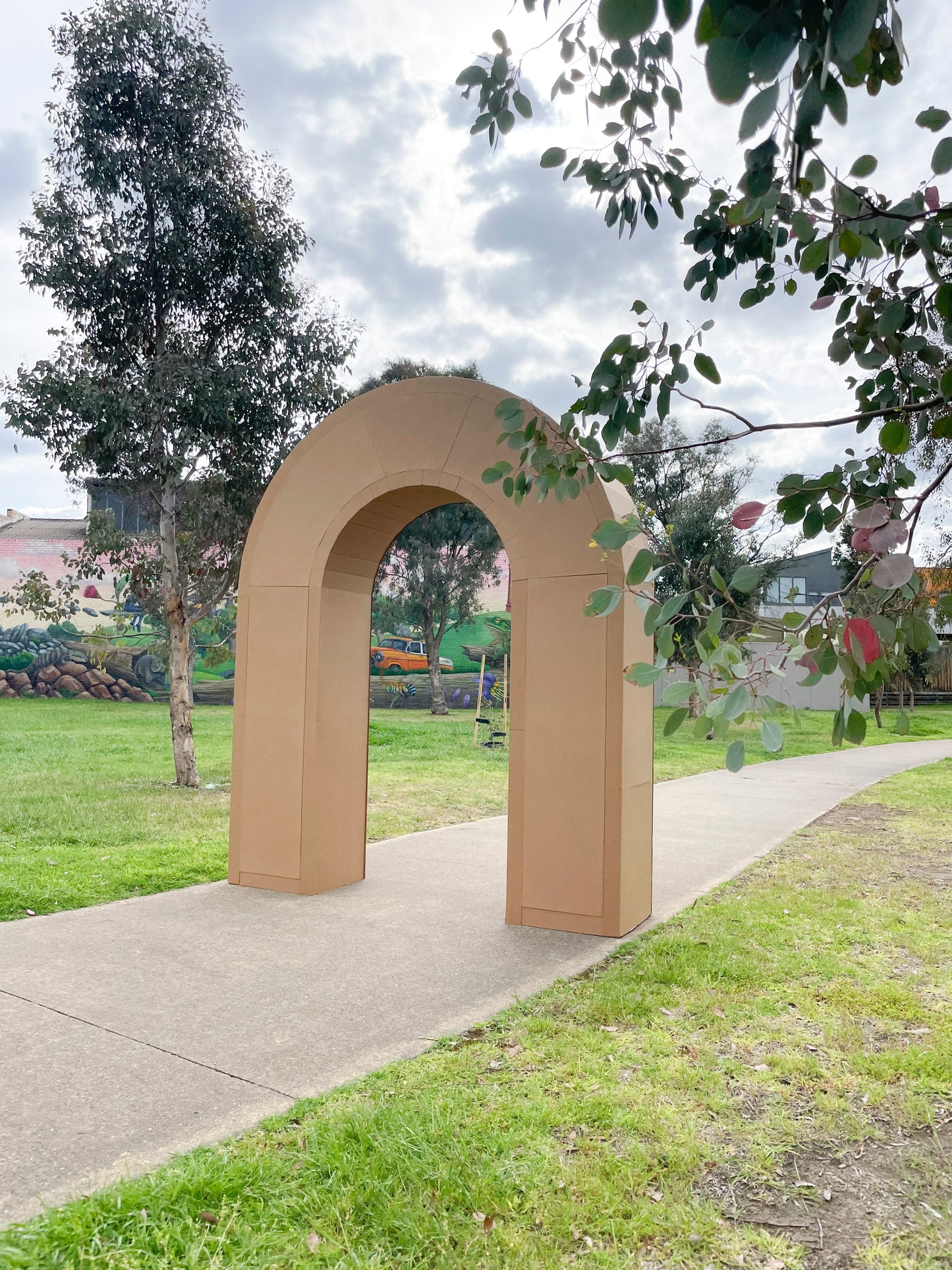
A cardboard event arch creates a strong visual entrance while framing the moment people arrive at your space.
At exhibitions, conferences and brand activations it naturally becomes a focal point. Guests walk through it, gather under it and often stop for photos, which makes it a powerful branding moment at the very start of an experience.
We design and build custom cardboard arches for exhibitions, trade shows, retail activations, theatre sets and events. Some are clean and architectural. Others become sculptural features with layered graphics, embossed elements or playful shapes.
Every arch is designed specifically for the project, the space and the brand.
How the Arch Works
Structural frame
Each arch is built around an engineered cardboard structure designed to support the graphics, decorative elements and the overall span of the installation.
The structure keeps the arch stable while remaining lightweight enough to transport and assemble inside event venues.
Typical size guidelines
Arches can be customised, but most projects work within these general dimensions.
- Maximum free span width: approximately 3.6 metres (larger widths possible by suspending from the ceiling)
- Typical total width: around 5 metres including the vertical sides
- Minimum walking clearance: 2100mm for comfortable pedestrian access
- Typical external height: approximately 2.5 metres
- Typical full structural height: approximately 3 metres including the base structure
These typical dimensions can usually be shipped on a double pallet, freight requiments confirmed during design phase
Decorative elements such as logos, sculptural features or layered panels can extend beyond the core structure. This often makes the arch appear visually larger than the structural frame.
Stability and hidden weighting
The vertical sides of the arch contain internal weight systems to keep the structure stable during the event.
Typically:
- around 60kg of weight is installed inside each side
- the weights are hidden inside the base structure
- the base sections may increase slightly in size to accommodate these weights
If the arch is placed near entrances, loading docks or areas where airflow may pass through the building, additional weight may be required.
Modular construction
Large arches are usually produced in multiple sections so they can be transported and installed inside venues.
These sections are:
- designed to move through lifts, corridors and loading docks
- pinned together during installation
- assembled onsite by our team
Once installed, the structure reads as a single arch.
Joins and seams
Because of the size of these installations, joins and seams are a normal part of the construction process.
Very large cardboard surfaces cannot realistically be manufactured as a single sheet. Small seams across larger surfaces will usually occur.
During the design process we work to manage these joins carefully.
Typical approaches include:
- positioning seams along structural lines or corners
- placing joins in less visible areas
- integrating seams into the graphic design
- covering joins with embossed or layered design elements
From normal viewing distances the arch reads as a single structure. At close range small seams may be visible, which is a natural part of large-scale cardboard construction.
Customisation and Branding
Arch shapes
Every arch begins with a base structure and then evolves depending on the creative direction of the project.
Several structural formats are commonly used:
- full curved arches
- rectangular arches
- rectangular arches with curved corners
- arches with 45 degree angled corners
Custom structural shapes can also be designed for specific projects.
Additional sculptural elements can be attached to create more complex installations.
Structural proportions
For larger arches the vertical sides are typically 500mm to 600mm wide.
This width provides structural stability and enough surface area for branding while keeping the arch visually balanced.
Graphics and branding
Arches often act as large-scale branded features within an event space.
Common options include:
- full printed graphics
- brand colours
- logos
- layered graphic panels
- cut-out shapes
- embossed or raised elements
Design elements can extend beyond the structural frame, making the arch feel larger and more sculptural.
Creative possibilities
Many clients treat the arch as a hero visual feature rather than simply an entry structure.
We often see arches combined with:
- sculptural brand elements
- themed installations
- product displays
- signage systems
- lighting or projection
This is where the arch becomes part architecture, part set design and part branding.
Sustainability
Recyclable materials
Temporary event infrastructure can create large amounts of waste. Cardboard installations provide a more responsible alternative while still allowing large creative builds.
Our arches are made from cardboard that can be recycled through standard recycling systems once the installation reaches the end of its life.
Much of the material used is produced from recycled fibre.
Lightweight production and shipping
Cardboard structures are significantly lighter than timber or metal builds.
This reduces:
- freight weight
- transport emissions
- installation labour
Reusable installations
Many arches are designed so they can be reused across multiple events.
Because the structures are modular and assembled onsite, they can be dismantled and stored between uses.
Supporting lower-impact events
Event organisers are increasingly looking for ways to reduce the environmental footprint of exhibitions and activations.
Cardboard installations allow large visual features to be produced while using recyclable materials and lighter construction methods.
Businesses are increasingly expected to consider the environmental and social impact of their decisions as part of a wider shift toward more regenerative economic systems.
Designing reusable cardboard structures is one practical way events can move in that direction.
Indoor Use and Weather Considerations
Designed primarily for indoor events
Our cardboard arches are primarily designed for indoor environments such as:
- exhibition halls
- convention centres
- retail spaces
- theatres
- galleries
- indoor event venues
Indoor spaces provide the stable conditions that allow cardboard installations to maintain their structural integrity and surface finish throughout the event.
Outdoor use
Outdoor installations are considered case by case.
Weather conditions such as rain, humidity and wind can affect cardboard surfaces and structural performance. Because of this we cannot guarantee the finish will maintain the same quality standard when exposed to the elements.
If an outdoor installation is required, the project may involve:
- specialised structural engineering
- additional internal weighting
- protective coatings or treatments
- location planning to reduce wind exposure
These factors are discussed during the design stage so we can assess whether the concept is suitable for the environment.
Semi-outdoor environments
Many arches are successfully installed in semi-covered locations, such as:
- undercover forecourts
- building atriums
- covered walkways
- outdoor areas with overhead protection
In these situations we assess wind exposure, nearby openings and general weather risk before confirming the design.
Planning the right solution
Every venue is slightly different. During the design process we review:
- the venue layout
- airflow and entrances
- access for installation
- expected environmental conditions
This helps ensure the arch performs safely while maintaining the visual finish expected for a professional event installation.
Ideal Applications
Cardboard arches work well anywhere an event needs a clear entry moment or strong visual feature.
Trade shows and exhibitions
Arches help define the entrance to a stand and draw attention from across exhibition aisles.
Brand activations
They create memorable entry points and strong photo opportunities for experiential campaigns.
Conferences and summits
Large arches can mark registration zones, stage entrances or themed event areas.
Retail activations and pop ups
An arch can frame the entrance to a temporary store or product launch space.
Theatre and set design
Arches regularly appear in scenic builds, stage sets and immersive environments.
Community events and workshops
Festivals and cultural events often use arches to define entrances or activity zones.
Frequently Asked Questions
How strong are cardboard arches?
The internal structure is engineered to support the scale of the installation and includes hidden weight systems for stability.
Can the arch be reused?
Yes. Many clients reuse arches for touring exhibitions, trade shows or recurring activations.
Can the arch be transported interstate?
Yes. Because the structure breaks into multiple sections it can be packed and transported efficiently.
Can we customise the shape?
Yes. While several common structural formats exist, custom shapes can be developed for specific projects.
Can the arch be printed with branding?
Yes. Most arches include full printed graphics, brand colours and logos. Layered elements and embossing can also be incorporated.
Can cardboard arches be used outdoors?
Our arches are primarily designed for indoor environments. Outdoor use is assessed case by case and may require additional engineering due to weather exposure.
How long does production take?
Lead times vary depending on size and complexity. For most event installations we recommend allowing several weeks for design, production and logistics.