


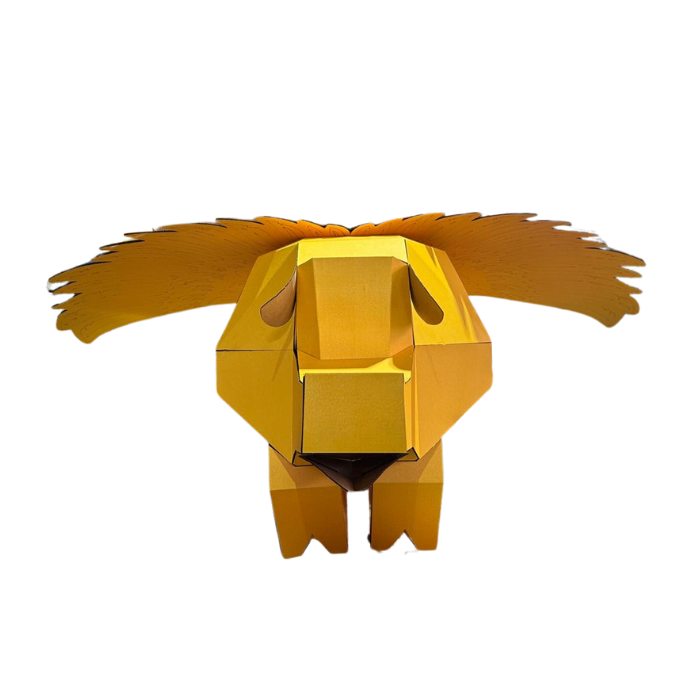
The cardboard pig is a sculptural piece that brings a bit of personality into a space straight away. It’s familiar, a little playful, and easy for people to connect with, which makes it a natural fit for events, exhibitions, and retail environments.
At smaller scales it works as a styled display element. As it gets larger, it becomes more of a feature, something people notice as they walk through and often stop to interact with or photograph. It’s simple in concept, but that’s what makes it flexible. It can sit in the background or become the main focal point depending on how it’s used.
How It Works
The pig is built from cardboard to create a solid three-dimensional form. Internally, it’s structured to hold its shape while still keeping the overall weight relatively low.
Depending on size and use, it can be:
Freestanding sculpture
Designed to sit directly on the floor with internal support and optional weighting if needed for public environments.
Plinth-mounted
Used when you want to elevate it slightly or create a more gallery-style presentation.
Interactive or functional
We can adapt the structure to include openings, flat surfaces, or reinforced sections if it needs to double as a display, prop, or light interaction piece.
Customisation and Branding
Size and scale
The pig can be produced at a range of sizes depending on the space. Smaller versions might sit around 500–800mm long for tabletop or display use. Larger pieces can scale up to 1.5–2m or more for installations and photo moments.
Surface finish and colour
You can keep the raw cardboard look for a natural, textured finish, or we can:
- apply printed graphics directly to the surface
- use coloured board layers
- add painted or illustrations
Branding and graphics
Logos, messaging, or patterns can be integrated into the body of the sculpture. This can be subtle or more graphic depending on how visible you want the branding to be.
Sustainability
Like all of our cardboard event installations, the pig is designed with reuse and end-of-life in mind.
The structure is made from responsibly sourced cardboard that can be recycled after use, or stored and reused across multiple activations. Because it’s lightweight compared to timber or metal builds, transport has a lower impact, especially for interstate projects.
We design these pieces so they can be packed down, reassembled, or re-skinned where possible. That means a single structure can evolve across campaigns rather than being built once and discarded.
Businesses are increasingly expected to consider how their events and activations impact the environment. Choosing materials and structures that are easier to reuse, recycle, and transport is one way to reduce that footprint in a practical, visible way.
Ideal Applications
Brand activations
A pig sculpture works well as a visual anchor that helps a space feel more considered and memorable.
Exhibitions and trade shows
Used as a feature piece to draw people into a stand or to support themed storytelling.
Retail displays and pop ups
Can be integrated into window displays or in-store environments to add depth and character.
Theatre and set design
Fits naturally into stylised or illustrative set builds where materials and form are part of the visual language.
Photo moments
Scaled-up versions create an easy, recognisable photo opportunity that people naturally engage with.
Workshops and community activations
Can be used as a creative centrepiece or even adapted for interactive experiences.
FAQs
Can it be reused?
Yes. Most builds are designed so they can be packed down, stored, and used again. We can also design it to be re-skinned or slightly modified for future campaigns.
Can you customise the shape or style?
Definitely. The proportions, detailing, and finish can all be adjusted. It can be more realistic, more geometric, or more abstract depending on the direction of the project.
Can it be printed or branded?
Yes. We can apply printed graphics, logos, or patterns directly onto the surface, or integrate branding more subtly into the design.
Can it be shipped interstate?
Yes. The structure can be designed in sections so it’s easier to transport and assemble on site.
How long does it take to produce?
Timing depends on size and level of customisation. As a general guide, allow a minimum of 4-6 weeks