


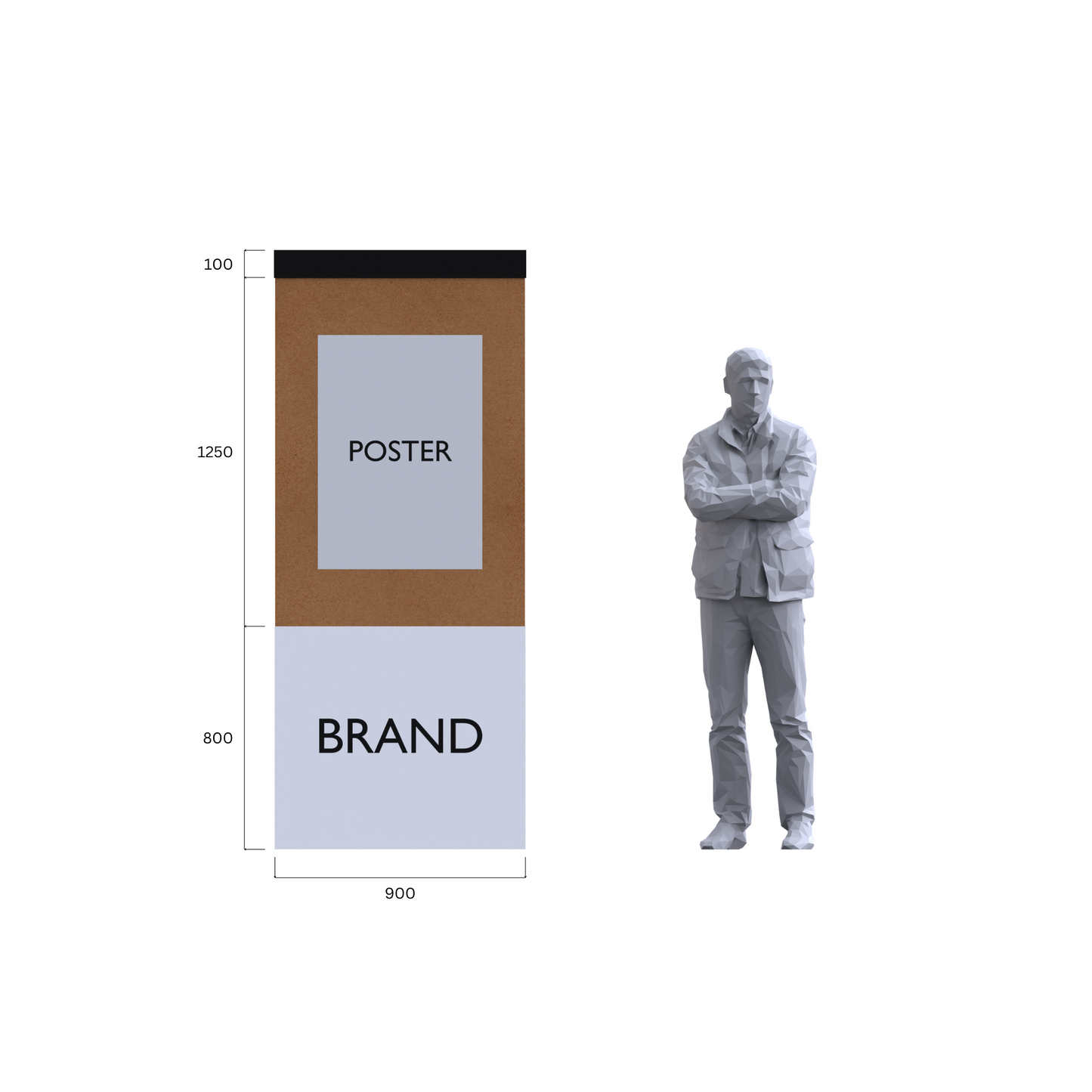
These freestanding cardboard signage towers are designed to bring structure and visibility into a space without needing walls, rigging or heavy infrastructure.
They work as vertical display elements that carry posters, branding and messaging on all sides. You’ll often see them used at entry points, within exhibition stands or across open-plan event spaces where signage needs to be seen from multiple directions.
They’re simple in concept, but they do a lot of work. They help guide people, reinforce branding and give a space a bit more presence without overcomplicating the build.
How It Works
Each tower is built as a hollow cardboard structure with an internal support system that keeps it stable and rigid.
The external faces are designed to hold printed panels or posters. This allows you to display the same message on every side or vary the content depending on how people move through the space.
Because the structure is lightweight, it’s easy to transport and position onsite.
The top section can be finished in a contrasting colour or material to frame the structure and give it a more defined presence within the space.
Customisation and Branding
Sizes and proportions
These signage towers can be scaled depending on the venue and how visible you want them to be.
A common size range is:
- 900mm wide
- 2m to 2.2m tall
This size works well for most events. It’s tall enough to be seen across a room but still practical to move, transport and install.
We can adjust proportions for tighter retail environments or scale them up for larger exhibition halls.
Branding and graphics
Each face of the tower can be used as a display surface.
Common applications include:
- posters
- event branding
- sponsor logos
- directional messaging
- schedules or program information
You can repeat the same design across all sides or treat each face differently depending on how the structure is used.
Sustainability
These signage towers are built from responsibly sourced cardboard and designed to be reused where possible.
The lightweight structure reduces transport impact, especially when compared to heavier materials typically used for event signage.
After the event, there are several pathways:
- reuse the structure for future activations
- update graphics for new campaigns
- repurpose components into new builds
- recycle through standard cardboard streams
For organisations looking to reduce event waste, this is a practical way to create strong visual impact while keeping materials in circulation.
Ideal Applications
Freestanding cardboard signage towers work well in a wide range of environments where clear, visible messaging is needed.
Common uses include:
- trade shows and exhibition stands
- brand activations and product launches
- retail pop ups
- entry and welcome signage
- wayfinding across large spaces
- sponsor recognition areas
- conference and event programming displays
- theatre foyers and installations
They’re especially useful in open spaces where vertical elements help guide movement and draw attention.
FAQs
How strong are the signage towers?
They’re designed for indoor event use and are structurally stable when installed correctly. The internal support system keeps them rigid and suitable for high-traffic environments.
Can they be reused?
Yes. Many clients reuse the structure and update the graphics for future events. They can also be adapted or repurposed into new builds.
Can you print directly onto the structure?
We usually apply printed panels or posters to the surfaces. This gives a clean finish and makes it easy to change the messaging later.
Can they be shipped interstate?
Yes. The structures are designed to flat-pack, which makes them efficient to freight and suitable for projects across Australia.
How long does installation take?
Assembly is straightforward and can be done quickly onsite. Multiple units can be installed efficiently as part of a standard bump-in schedule.
Can we customise the size or shape?
Yes. The size, proportions and layout can all be adjusted. We can also design them to integrate with other elements in your space.
Are they suitable for outdoor use?
They’re primarily designed for indoor environments. Outdoor use can be considered depending on conditions, but we’ll usually recommend specific adjustments based on the setup.