

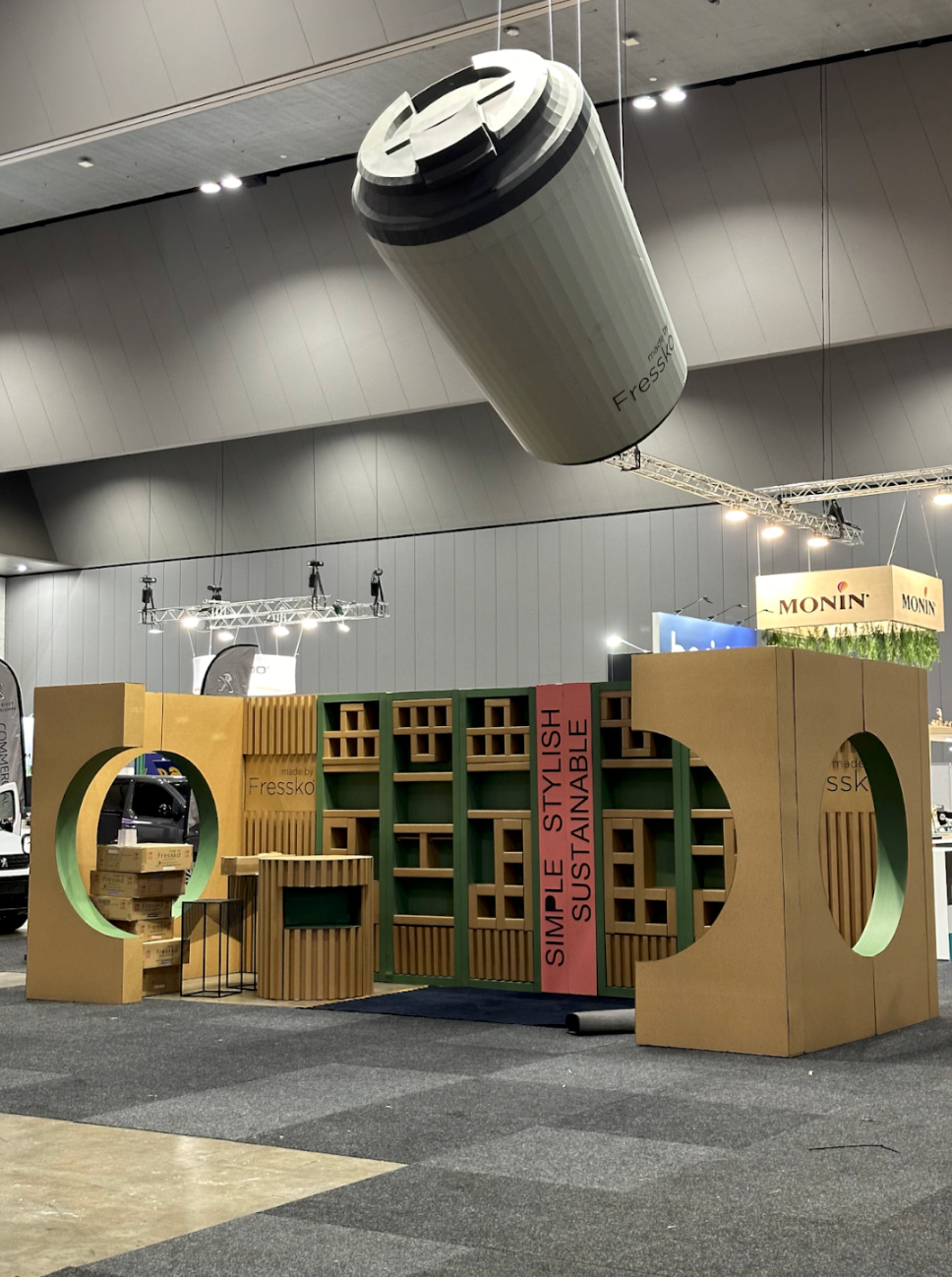
Suspended signage is one of those things that can completely change how a space feels without taking up any floor space.
Because cardboard is lightweight, it’s actually ideal for overhead installations. We regularly design suspended cardboard signage for exhibitions, trade shows, retail environments and large-scale activations where visibility matters from a distance.
These pieces can be as simple as hanging logos or as complex as multi-layered shapes, directional signage systems or sculptural elements that sit above a space and draw people in.
We’ve delivered a lot of these now, and most projects involve working closely with riggers and engineers to make sure everything is safe, compliant and practical to install.
How Suspended Cardboard Signage Works
At its core, suspended signage is about balancing weight, structure and fixing points.
Cardboard structures are designed with internal reinforcement so they hold their shape while remaining light enough to hang safely. Depending on the design, this might include:
- layered panels for strength
- internal rib structures
- interlocking components that distribute weight evenly
We typically design signage to connect to:
- existing rigging points in exhibition venues
- truss systems or custom frames
- ceiling-mounted cables or wires
We work with engineers to review load requirements and sign off on the design before install. That process becomes especially important for public spaces and large venues.
Customisation, Sizes and Branding
Suspended signage is one of the most flexible formats we work with.
You’re not locked into standard shapes or sizes. Most pieces are designed specifically for the space they’re going into.
Shapes and formats
We regularly create:
- suspended logos and lettering
- circular or ring signage
- directional signage systems
- layered or double-sided signs
- sculptural or abstract forms
Because everything is custom, shapes can be simple and clean or more expressive depending on the project.
Sizes
Sizes vary a lot depending on ceiling height, viewing distance and venue restrictions.
Typical ranges include:
- 1–2m wide signage for smaller booths or retail spaces
- 2–4m wide signage for trade shows and exhibitions
- larger multi-piece installations for atriums or open venues
Lightweight construction makes it possible to scale up without the same constraints as heavier materials.
Finishes and branding
We can apply a range of finishes depending on the look you’re after:
- natural kraft cardboard for a raw, sustainable aesthetic
- black or coloured board
- full CMYK printed graphics
- layered graphics or dimensional lettering
We can also integrate lighting considerations, cut-outs, or layered depth to create more visual impact from below.
Sustainability
Suspended signage is a good example of where material choice makes a real difference.
Cardboard allows large-scale overhead signage to be produced with less material, less weight and less transport impact compared to traditional builds.
We focus on:
- responsibly sourced cardboard
- designs that minimise material waste
- lightweight components that reduce freight impact
- structures that can be disassembled and reused
In many cases, signage can be repurposed for future events, stored flat, or recycled at the end of its life.
Businesses are increasingly expected to consider their environmental and social impact. Working with materials like cardboard helps support that shift toward more responsible event production, where visual impact doesn’t come at the cost of unnecessary waste.
This aligns with a broader movement of businesses rethinking how things are made, used and disposed of, and how that contributes to a more regenerative economy .
Ideal Applications
Suspended cardboard signage works particularly well in spaces where visibility and wayfinding matter.
Common uses include:
- trade show booths and exhibition stands
- brand activations and experiential marketing spaces
- retail environments and pop ups
- conference signage and directional systems
- museum and gallery installations
- theatre and stage design
- large open venues where floor signage gets lost
It’s especially effective in busy environments where people are navigating from a distance and need clear visual cues.
FAQs
How strong is suspended cardboard signage?
Stronger than most people expect. The internal structure does the heavy lifting. Designs are engineered to hold their shape while staying lightweight enough for safe suspension.
Can it be reused?
Yes. Many designs are created with reuse in mind.
Do you provide engineering for suspended installs?
For larger or public-facing installations, we work with engineers to review and sign off on the design. This ensures everything meets venue and safety requirements.
Can it be shipped interstate?
Yes. Most signage is designed to be small enough to fit onto pallets or break into sections, which makes transport straightforward across Australia.
How long does it take to produce?
Lead times depend on complexity, but typically range from 2 to 4 weeks. Larger or engineered builds may require additional time.
Can we customise the shape and size?
Absolutely. Almost every suspended signage project is custom. We design around your space, brand and installation requirements.
Can it be printed on both sides?
Yes. Double-sided printing is common for suspended signage so it reads clearly from multiple directions.